

Mar 11, 2016
ProQuest Outage
Tomorrow night (March 12, 2016) starting at 7:00 p.m. and running for eight hours, ProQuest products will be unavailable. This will affect the ProQuest databases and ProQuest Research Companion. ProQuest will be updating their servers.

Feb 11, 2016
Gravitational waves directly measured: Big news from the world of physics and astronomy!
by John W. Weiss
Assistant Professor of Physics
Saint Martin's University
Gravity waves -- slight ripples in spacetime caused by any object with mass that accelerates -- were predicted 100 years ago by Albert Einstein based on his (now well-tested) Theory of General Relativity. Physicists have known that they exist for 30 years thanks to seeing their effects on the orbits of two pulsars (super-dense stellar remnants) orbiting each other. But this morning we awoke to the news that one of the gravity wave detecting teams has positively directly observed these ripples and it may well be the most exciting and significant physics discovery in most of our lifetimes.
Gravity waves are emitted by nearly every object in the universe, but most emit very weak, small waves. Even massive black holes, such as the ones detected, emit waves that make a person stretch or compress by one billionth of a trillionth of a meter. Such a small change is very challenging to detect -- to say the least -- but huge teams of scientists (the teams run in the hundreds) working hard to solve the myriad of technical hurdles has positively identified the signal of two merging black holes.
 |
| NASA visualization of gravity waves produced by merging black holes. Image by NASA, from Wikimedia Commons, public domain |
Apart from the excitement of finally detecting Einstein's predicted waves, this discovery has physicists and astronomers buzzing thanks to the opportunities it will hopefully open up. Every time physicists have found new waves to look at signals from the universe (the telescope; other, invisible wavelengths like infrared; neutrinos; etc.), astronomers have quickly been able to learn exponentially more about our universe from the new perspectives offered. Gravity waves will hopefully similarly give us a fresh view of our universe and let us see things we were previously unable to observe.
 |
| The Northern Leg of the Laser Interferometer Gravitational-Wave Observatory on the Hanford Reservation in Benton County, WA which helped measure gravitational waves. Image by Umptanum from Wikimedia Commons, CC BY-SA |
Jan 26, 2016
One Less Password to Remember!
Interlibrary loan just got a bit easier!

Scot Harrison, Dean of the O'Grady Library, announced that ILLiad, Saint Martin's interlibrary loan management system, has been updated to accept your standard SMU login information rather than requiring a separate username and password.
Now when you click a link in Saints search or any of the academic databases to request an item or click the direct link to ILLiad on the library's homepage, you will be taken to the login screen below:

From here, simply enter your regular SMU login information.
Your ILLiad requests and history should be readily available to you. First-time users will be taken to a new registration screen and will need to provide a minimum amount of information. If you have any questions please contact Stefanie Gorzelsky, the circulation manager, or Joyce Hall, interlibrary loan processor.
Jan 19, 2016
Ever Struggle with Printing in the Library?
Thanks to the efforts of Jessilyn Dagum (SMU sophomore), Stefanie Gorzelsky, and Serin Anderson, the library has newer, easier to use instructions for the printer on the main level.
Posters are being created for the printers on the upper and lower levels, which have different machines.
 |
| Stefanie Gorzelsky, Serin Anderson, and Jessilyn Dagum stand by their newly-designed posters in the main-level library print alcolve. |
Jan 11, 2016
Changes to Saints Search
Saint's Search on the O’Grady Library home page will have a small update within the next 24 hours.
Currently the Saints Search system (http://saintssearch.stmartin.edu) does not require a login.
However, logging in provides a number of benefits including:
To ensure that all students, faculty and staff see and experience a full range of resources and functionality in Saints Search, we will be implementing an automated sign-in feature. Running a search will look exactly the same, but a sign-in box will appear that looks like the image below. All current faculty, staff and students will simply need to sign in with their normal network ID and password.

Please send any questions or comments to sanderson@stmartin.edu
Currently the Saints Search system (http://saintssearch.stmartin.edu) does not require a login.
However, logging in provides a number of benefits including:
- Retrieval of all possible results for a search. Some databases – Scopus and MLA are good examples – require that a searcher be logged in to see citations.
- Access to “My Account” to see all library materials checked out and O’Grady/Summit requests.
- Use of the e-Shelf, a handy tool for saving citations with a single click.
- Ability to request items through Interlibrary loan and Summit.
To ensure that all students, faculty and staff see and experience a full range of resources and functionality in Saints Search, we will be implementing an automated sign-in feature. Running a search will look exactly the same, but a sign-in box will appear that looks like the image below. All current faculty, staff and students will simply need to sign in with their normal network ID and password.

Please send any questions or comments to sanderson@stmartin.edu
Nov 16, 2015
Students Create Whiteboard Animations
By Olivia Archiblad
As part of their creative writing projects in Dr. Olivia Archibald’s UNI 101 class this fall, students made RSA animated-style videos in the O’Grady Library’s new multimedia center. Dr. Belinda Hill, Associate Professor in the Education Department, directed the project.
 |
| Dr. Belinda Hill advises Sarah McCreary and Alexis Schupbach on their animation |
RSA animations, also known as whiteboard animation and video scribing, involve an “artist” creating cartoon images on a whiteboard as a voice-over narrator explains a concept or, in the case of the UNI project, a personal narrative (we only see the artist’s hand and the whiteboard’s illustrations).
 |
| Brooks Ellingsen and Daniel Echtle work out their animation |
In the UNI 101 project, students created whiteboard drawings that depicted creative nonfiction stories that they had written in an earlier UNI project. Each student used an IPAD to create a stop-motion camera effect as the student drew the illustration representing events in the narrative, and then created a voice-over by developing a 1-2 minute telling of the story.
 |
| Gabriela Virgen and Emma work out their project |
The project was one that, as with other assignments in the class, focused on creativity, imagination, and experimentation, while also encouraging Community as most of the students worked in pairs.


Shea Kelly and James Fielder prepare to start shooting their stories
Nov 6, 2015
How Saint Martin's Came to Be
Fr. Peter Tynan, O.S.B.
How did Saint Martin’s University get here? We often take this beautiful place for granted, but just you have a family history, Saint Martin’s has a family history. Why not take a moment to find it out?

On the lower level of the O’Grady Library, just outside the curriculum room you will find a display that talks about our school’s early history. Saint Martin’s comes from a long lineage of monastic schools. In 1890 monks from Saint John’s Abbey in Minnesota heard about the need for priests and schools out in the newly established Washington State (1889). They first came to Tacoma and founded Holy Rosary Parish, whose steeple is easily recognizable from I-5. Once this base parish was established the monastic priest, Fr. William Eversman, began looking for a good location to build a school and monastery. The search was not easy. Land to the north was at a premium. An available location west of Centralia was deemed too remote. What to do?

 |
| Fr. William Eversman |
Fortunately, the former Olympia mayor and businessman, A. H. Chambers, heard of the monks desire to build a school and felt it would benefit his community. So Chambers contacted the monks and used his connections to have some public land near the Lacey (then called Woodland) train station put up for auction so the monks could build there. Not everyone was excited to have Roman Catholic monks move into the area, however. Members of an anti-Catholic organization attempted to outbid the monks for the land. They failed because the auctioneer deemed the sale to be cash only, which the Chambers and the monks had fortunately brought with them.
 |
| A. H. Chambers |
The monks began building in January 1895 and sent out a prospectus to towns in the region. Despite having a tuition of $100 plus fees only one student arrived in September at the newly finished schoolhouse, Angus McDonald. Fortunately for the school, more students began to come here and the rest, as they say, is history.
 |
| Caricature of Angus McDonald |
Come down and learn more about our University’s beginnings at the O’Grady Library.

Oct 28, 2015
APA/MLA Gorilla in the Room?

Papers are coming due...need a refresher on APA and MLA styles?
There's a site for that:
http://stmartin.libguides.com/citations
Image by Brett from Flickr
Creative Commons BY NC
Oct 14, 2015
JSTOR access issues
For the last few days, there have been intermittent problems accessing
journal content on the JSTOR platform. This is an issue affecting all
users of JSTOR (not just here at Saint Martin's), and they are working
to correct it. For more information, please see the link below for updates.
http://about.jstor.org/jstor-help-support/jstor-updates
http://about.jstor.org/jstor-help-support/jstor-updates
Sep 25, 2015
Day Five • Page Five: Multiplication of the Loaves and Fishes

Bailey Walter, M. Div
Assistant for formation and outreach at the School of Theology and Seminary at Saint John's University
 In Mark’s gospel, Jesus’ heart is moved by a group of people who are hungry. Upon receiving the
 request to let the people go and buy food, Jesus tells his disciples to feed them. With five loaves and two fish, Jesus and his disciples feed the crowd. This beautiful illumination captures the multiplication of the loaves and fishes with its abundance of gold and color that consumes much of the page, alluding to the abundance at the divine banquet. Today, our world contains a much larger crowd of hungry people than the 5,000 that Jesus encounters in this story; close to one billion people go hungry each day.
In his Message for World Food Day in 2013, Pope Francis called world hunger a global scandal. Many of us who live in developed countries view food as a luxury and have access to it in abundance. Catholic Social Teaching and Pope Francis remind us that the primary function of food is to nourish our bodies and sustain life. Food is a basic human right for all people. We each have a responsibility to heed Jesus’ instructions that he gave to his disciples when he said, “You give them something to eat” (Mk 6:37). There are many ways in which we can help: participation in a local food shelf, getting involved with national relief efforts such as Catholic Relief Services, and being conscious of personal food consumption and waste, just to name a few. How will you respond to Jesus’ call to feed the crowd?
Image credit: Multiplication of The Loaves and Fishes, Donald Jackson, © 2002, The Saint John’s Bible, Saint John’s University, Collegeville, Minnesota USA. Scripture quotations are from the New Revised Standard Version of the Bible, Catholic Edition, © 1993, 1989 National Council of the Churches of Christ in the United States of America. Used by permission. All rights reserved.
Sep 24, 2015
Day Four • Page Four: A Reflection on Peter’s Confession

Rev. Michael Patella, OSB
Professor of New Testament and seminary rector at the School of Theology and Seminary at Saint John's University, Collegeville, MN In this illumination, Jesus is rendered entirely in gold. He is shown in the center with the enlarged text, “You are the Messiah the Son of the Living God” (Mt 16:16). He is alive, fully incarnate, standing in the midst of a contemporary representation of hell.
The Church is the sacramental presence of Christ in the world. Just as Satan and the forces of evil tried in vain to eliminate Christ by death, they attempt, also in vain, to eradicate those baptized in Jesus’ name by the same means. Christ’s words to Peter, “And I tell you, you are Peter, and on this rock I will build my church, and the gates of Hades will not prevail against it” (Mt 16:18) is the guarantee that sin and death have long failed in subverting God’s ultimate plan of redemption.
Historians agree that we are in a period of Christian persecution greater in scope than the Church has ever before faced, even greater than the persecutions under ancient Rome. The faith and hope etched on the face of current martyrs, such as the Coptic Christians on the beach in Libya just before ISIS beheaded them, is proof that the gates of Hades (Hell) will not “prevail against it” (Mt 16:18). In Pope Francis’ recent homily celebrating the feasts of Peter and Paul, he commended these martyrs for their supreme witness as they died with Jesus’ name on their lips. Additionally Pope Francis implored that those of us, who are fortunate to experience peace and prosperity, continue to witness to Christ as well as set aside time to pray to God, who does not abandon his children. How else might you stand in solidarity with our Christian brothers and sisters undergoing persecution?
Image credit: Peter’s Confession, Donald Jackson, © 2002,
The Saint John’s Bible, Saint John’s University, Collegeville, Minnesota USA. Used by permission. All rights reserved.
Sep 23, 2015
Day Three • Page Three: A Reflection on the Ten Commandments

Rev. Michael Patella, OSB
Professor of New Testament and seminary rector at the School of Theology and Seminary at Saint John's University, Collegeville, MN Human society and civilization depend upon right relationships, and those relationships can only succeed when there is proper respect shown to God and neighbor. The Ten Commandments, as a compendium of laws foundational to the well-being of all humankind, connects the homage due to God alone (Ex 20:1-11) with the obligations and deportment shown to neighbor (Ex 20:12-17).
 In Laudato Si’ Pope Francis proclaims that when we neglect to identify God as the all-powerful One who alone has created the world, “we end up worshiping earthly powers, or ourselves usurping the place of God” (75). When we place ourselves at the center of the universe, our personal and communal lives will disintegrate and vanish as do the letters at the bottom of the page. Only when we as humans recognize that God is the Lord of the cosmos and we are the fruit of his loving creation do human relationships function in a way that reflects the love and goodness of our Creator.
Exodus 20:1 says, “Then God spoke all these words...” What does God’s voice sound like as you hear the Ten Commandments? In what ways do God’s commands allow you to love more freely?
Image credit: Ten Commandments, Thomas Ingmire, © 2002 The Saint John’s Bible, Saint John’s University, Collegeville, Minnesota USA. Used by permission. All rights reserved.
Sep 22, 2015
Day Two • Page Two: A Reflection on Abraham and Sarah

Rev. Michael Patella, OSB
Professor of New Testament and seminary rector at the School of Theology and Seminary at Saint John's University, Collegeville, MN The Menorah, the ancient symbol of Judaism, repeats across the double folio, dominating the illumination. This is the moment in salvation history where the Lord seals the covenant with Abraham, a moment so important that it is recounted twice, once at Genesis 15:1-21 and again at Genesis 17:1-19.
While Abraham also has a son, Ishmael, through Sarah’s maidservant, Hagar, the Lord forms his covenant through Isaac, the son of Abraham and his wife, Sarah. Their descendants include Isaac and Rebekah’s son, Jacob, and his twelve sons along with the whole royal line of David, a lineage that ends with Jesus. For this reason, the Menorah also becomes the primary symbol in the Matthew frontispiece, which recites Jesus’ genealogy and confirms his connection with the Abrahamic Covenant.
Pope Francis reminds us in Evangelii Gaudium, that this covenant between God and the Jewish people has never been revoked (247). As Christians we must honor the sacred roots that our identity has in Judaism. We are enriched by the complementarity of our concern for justice and well-being of peoples, which we have inherited from the Jewish tradition (247-249).
In what ways do you hold the covenant sacred over time?
Image credit: Abraham and Sarah, Donald Jackson, © 2003, The Saint John’s Bible, Saint John’s University,Collegeville, Minnesota. Scripture quotations are from the New Revised Standard Version of the Bible, Catholic Edition, © 1993, 1989 National Council of the Churches of Christ in the United States of America. Used by permission. All rights reserved.
Sep 21, 2015
Day One • Page One: A Reflection on Creation

Dr. Barbara Sutton
Associate Dean for Formation and Outreach at the School of Theology and Seminary at Saint John's University In this illumination Donald Jackson, artist and calligrapher, dares to illuminate that which leaves us speechless. Seven days of creation, choreographed by God: heavens and earth, sea and sky, birds and beasts. With eyes of faith, a new ‘world view’ emerges. Chaos turns into order. God calls forth light from darkness; and then breathes life into human kind. In this first panel we see a sliver of gold shining in the center of darkness and chaos. It explodes outward as if driven by a powerful force that wrestles the remaining days into order with God hallowing the seventh day. These seven days, hinged with gold, open the doors of a greater mystery that rest in silence on the horizon. Silence is golden. Entering the seventh day requires courage to enter the silence as the Unspeakable shows itself as the thread of light that holds the web of life together.
 While this illumination appears to be a well-oiled machine, brought out of chaos and hinged together by God, it is not. It does not run on its own! It has been ruptured by sin. Pope Francis in his Encyclical Letter Laudato Si’ suggests that human life is hinged on three fundamental and closely intertwined relationships: with God, with our neighbor, and with the earth itself. He writes, “The harmony between the Creator, humanity and creation as a whole was disrupted by our presuming to take the place of God and refusing to acknowledge our creaturely limitations. This in turn distorted our mandate to ‘have dominion’ over the earth (cf. Gen 1:28), to ‘till and keep it’ (Gen 2:15)…our sin is manifest in all its destructive power in wars, violence and abuse, the abandonment of the most vulnerable, and attacks on nature” (66).
On the sixth day God looked at everything and saw it was very good. God wanted us to revel in the Garden and in love. Woven into the sixth day of this illumination is Chris Tomlin’s coral snake leading us away from resting in God symbolized by the figures turning their backs away from the light.
We live in a world where constant activity is the norm. We run from one event to another, arriving at a new place before our minds and hearts are able to let go of what we were doing or where we were. We pass through life and do not allow ourselves to experience deeply or be touched by people. We are in need of soul-searching. We must learn again love, compassion and honor so that we might heal the earth. How might you be held in the light? Restore harmony to creation?
Image credit: Creation 2, Donald Jackson, © 2003, The Saint John’s Bible, Saint John’s University, Collegeville, Minnesota, USA. Used by permission. All rights reserved.
Sep 16, 2015
O'Grady Library helps celebrate Pope Francis's visit to the United States
In an effort coordinated by the Saint John's School of Theology and Seminary in Collegeville, Minnesota, the O'Grady Library at Saint Martin's University is participating in the "Illuminating the Mission: 7 Pages-7 Days" project to celebrate the historic first visit of Pope Francis to the United States. In this effort, institutions that hold and display copies of the Saint John's Bible will display for seven days the same page and have a common brief reflection on the image featured on each page as a gesture of unity.
Rev. Michael Patella, OSB, of the Saint John's School of Theology and Seminary said, "These particular Illuminations were specifically chosen because they resonate with values Pope Francis holds dear: hospitality; concern for the poor, sick, and marginalized; the dignity of all people; and care for creation."
The final volume of the of the Saint John's Bible was recently presented to Pope Francis in April. Abbot John Klassen, OSB, of Saint John's Abbey reported that the Pope reacted to the illumination of the Vision of the New Jerusalem by "[lifting] his hands with a smile on his face in a gesture of joy and appreciation."1 The volumes are a contemporary illuminated Bible that were commissioned by Saint John's Abbey and University in 1998.
The 7 Pages-7 Days effort will feature illuminations for passages in in the books of Genesis, Exodus, Matthew, Mark, and the Acts of the Apostles. If you are interested in seeing SMU's copy of The Saint John's Bible or have any questions about it, please contact Fr. Peter Tynan, University Chaplin and Archivist: Fr_Peter@stmartin.edu.
A list of participating institutions includes:
1. See "His Holiness Pope Francis Received Final Volume of The Saint John's Bible at the Vatican" on The Saint John's Bible website: http://www.saintjohnsbible.org/promotions/lp/francis/
Rev. Michael Patella, OSB, of the Saint John's School of Theology and Seminary said, "These particular Illuminations were specifically chosen because they resonate with values Pope Francis holds dear: hospitality; concern for the poor, sick, and marginalized; the dignity of all people; and care for creation."
 |
| SMU's copy of the Saint John's Bible in the entry way of the O'Grady Library |
The 7 Pages-7 Days effort will feature illuminations for passages in in the books of Genesis, Exodus, Matthew, Mark, and the Acts of the Apostles. If you are interested in seeing SMU's copy of The Saint John's Bible or have any questions about it, please contact Fr. Peter Tynan, University Chaplin and Archivist: Fr_Peter@stmartin.edu.
A list of participating institutions includes:
|
Assumption College - MA
|
Loyola Notre Dame Library - MD
|
|
Azusa Pacific University - CA
|
Loyola University Chicago - IL
|
|
Baptist Theological Seminary - VA
|
Malone University p OH
|
|
Berea College
|
Molloy College - NY
|
|
Brigham Young University - UT
|
Mount Marty College - SD
|
|
Carson Newman College - TN
|
Mount Saint Mary College - NY
|
|
Cathedral Church of St. John - AZ
|
Mount St. Benedict Monastery - Website
|
|
Cathedral of Christ the Light - CA
|
Saint Agnes Medical Center - CA
|
|
Chaminade University - HI
|
Saint John's University - MN
|
|
College of Saint Mary - NE
|
Saint Martin’s University - WA
|
|
Creighton University - NE
|
St Mary's University College - Canada
|
|
Edgewood College - WI
|
Saint Catherine University - MN
|
|
Fairfield University - CT
|
St. Hubert Catholic Community - MN
|
|
Franciscan Renewal Center - AZ
|
St. John's Cathedral - CO
|
|
George Fox University - OR
|
St. Mary's College - IN
|
|
Gonzaga University - WA
|
Saint Peter's University - NJ
|
|
Gustavus Adolphus College - MN
|
University of Dayton - OH
|
|
Holy Family Catholic High School - MN
|
University of Mary - ND
|
|
Houston Baptist University - TX
|
University of Minnesota - MN
|
|
John Carroll University - OH
|
University of Portland OR
|
|
La Roche College - PA
|
Xavier University - OH
|
|
Loyola Marymount University – CA
|
1. See "His Holiness Pope Francis Received Final Volume of The Saint John's Bible at the Vatican" on The Saint John's Bible website: http://www.saintjohnsbible.org/promotions/lp/francis/
Sep 15, 2015
Welcome Student Workers!
After the usual hectic start of the semester, the 2015-16 contingent of library student workers has been set and oriented on Friday evening, September 11.

Students had training in their various duties, created and presented slides to each other on policies, and decorated library carts which they used in running a relay race.

And, of course, pizza.


Students had training in their various duties, created and presented slides to each other on policies, and decorated library carts which they used in running a relay race.

And, of course, pizza.

Aug 31, 2015
Straight from the Ant's Mouth: Food in the Library
Ever wonder about what you can and can't eat in the library? Student Jessilyn Dagum interviews a sugar ant to clear it all up.
Aug 28, 2015
Hey! Where did Academic Search go?
Starting Fall 2015,the library has replaced the EBSCO
Academic Search Premier and Business Source databases with two similar ProQuest
products, ProQuestCentral and ABI/INFORM Complete.
The library made the decision to move forward with an Orbis
Cascade Alliance offer for a suite of new ProQuest products. Some of
these will be replacing products that we have had for a number of years, like Academic Search Premier, while
others will offer brand new content and research tools. This decision
continues the expansion of ProQuest offerings that started last year with new
social science databases including: Social Services Abstracts, Public
Affairs Information Service (PAIS), and Sociological Abstracts among
others.
These new products add a suite of subject-specific research
tools and content – particularly for the humanities and sciences – that were
previously unavailable. A sample of the new content and tools include:
- FIAF: International Index to Film Periodicals Plus
- International Index to Music Periodicals Full Text
- Environmental Engineering Abstracts
- More than 100,000 full-text dissertations
- See a full list of ProQuest databases
In addition to new content and tools, the ProQuest package
offers some significant advantages. All of the ProQuest content will be
findable in the library’s Saints search discovery system (unlike EBSCO), the mix of ProQuest products provides more full text overall, and the new ProQuest interface has a clean look with more filtering options.

While Academic Search and Business Source are no longer available, we continue to subscribe to a number of EBSCO products core to many
of the departments and schools on campus including:
- PsycINFO
- PsycARTICLES
- ATLA Religion
- Catholic Periodicals and Lit
- Old & New Testament Abstracts
- Education Research Complete
- Communication & Mass Media
- MLA
- Mental Measurements & TIP
Questions? Please send an email to Serin Anderson, sanderson@stmartin.edu
Jul 31, 2015
Parting Is Such Sweet Sorrow
The O'Grady Library is sad to see the departure of technology coordinator, Erik Gregory. An SMU alum, Gregory has worked in the library for much of the past 12 years. He is leaving his position to become a stay-at-home dad for his two daughters (number two is due within the month).
He worked in the library from September 2003 to 2009 while working on his English degree. He worked at the reference desk, the circulation desk, in the cataloging department, and eventually as evening supervisor. He returned to SMU in March 2013 to resume as evening supervisor and then became the technology coordinator that summer.
 |
| Erik Gregory poses with his fairy-princess daughter on Halloween 2014 |
He worked in the library from September 2003 to 2009 while working on his English degree. He worked at the reference desk, the circulation desk, in the cataloging department, and eventually as evening supervisor. He returned to SMU in March 2013 to resume as evening supervisor and then became the technology coordinator that summer.
Gregory said working in the library has been a good experience. He claimed working with the people in the library has been his favorite aspect of his years of service, especially interacting with his co-workers. "It's easy to work with people you like and respect," he observed. He found deep satisfaction in supervising student workers, watching them grow and develop. He said he will also miss working with foreign exchange students, helping them find materials and answering their questions.
 |
| Jackie Nordquist, Stefanie Gorzelsky, Gregory, and Serin Anderson chat during his farewell party |
Though Gregory will be missed by all of the staff at the O'Grady Library, Jackie Nordquist, who worked under him when she was an undergraduate and is now a library associate, will especially miss working with him. "Erik's quick wit and humor has always made O'Grady a fun and comfortable place to work. His presence will be greatly missed and the library will not be the same," she said.
All of us at the O'Grady Library wish Gregory all the best as he devotes more time and attention to his family!
 |
| Gregory grabs a piece of pizza during his farewell party. |
Jun 30, 2015
New STEM Study Space Coming

To make this space available, the print periodicals have been moved up to the southwest corner of the upper level of the library...

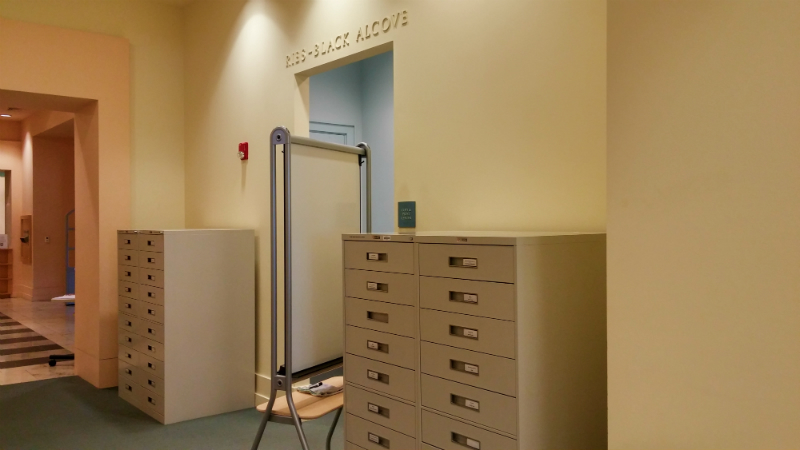
and the microfiche and microfilm file cabinets have been moved to the main level of the library near the printer alcove and closer to the respective readers for both media.
Subscribe to:
Posts (Atom)